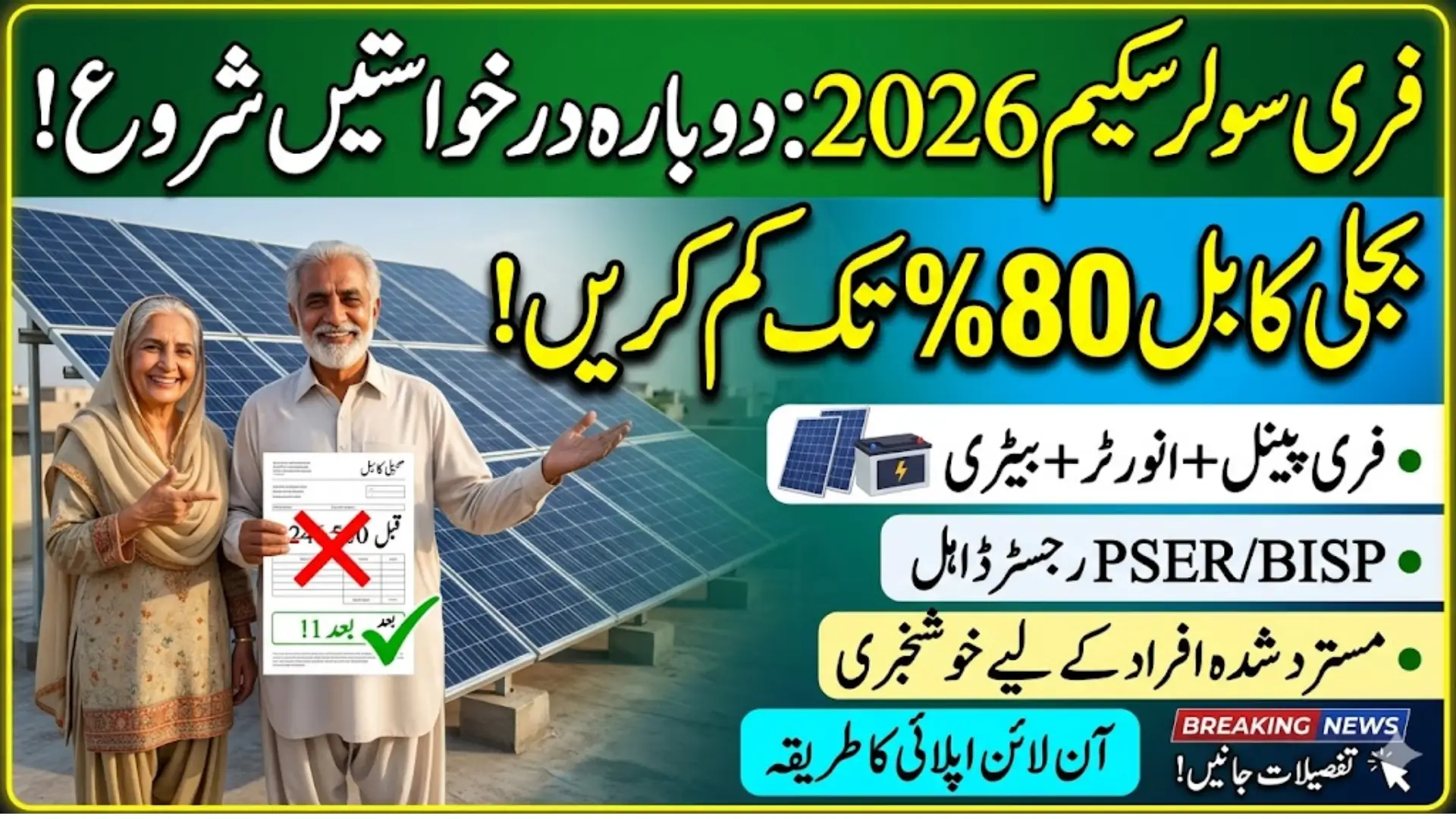
Free Solar Scheme 2026 Re-application
Free Solar Scheme 2026 Re-application: Government of Pakistan has relaunched its ambitious renewable energy initiative, giving millions of low-income households a second opportunity to benefit from subsidized solar power Free Solar Scheme 2026 re-application process is now open, and understanding every aspect of this program is essential for eligible families who missed the first round or were previously rejected.

With energy poverty remaining a critical challenge across rural and urban areas, the government has restructured the scheme to make it more accessible and transparent. The re-application phase includes updated eligibility criteria, streamlined verification procedures, and a digital registration portal that enables applicants to track their status in real time. Families who qualify will receive solar panels, inverters, and batteries at zero cost, allowing them to generate electricity independently and reduce their monthly utility bills significantly.
You Can Also Read: Solar pmrugb.Gov.pk Selected Applicants List Online Check Complete Guide Step by Step
Free Solar Scheme 2026
Solar Panel Distribution Program Eligibility Criteria 2026
To ensure the program reaches those who genuinely need it, the government has defined specific eligibility requirements for the re-application process. Only households that meet the prescribed financial and residential thresholds will be considered for solar panel installation. Applicants must be registered under the formerly known as PSER, which is managed by the Benazir Income Support Programme.
The eligibility framework has been revised to include a broader group of beneficiaries compared to the initial launch. Households consuming fewer than 200 units of electricity per month are considered priority applicants, while those with a poverty score below a specified threshold on the PSER database are automatically flagged for consideration. Additionally, applicants must own or legally occupy the residential property where installation will take place, and the dwelling must be structurally suitable to support rooftop solar equipment.
You Can Also Read: Breaking News! Punjab Govt Gives Last Deadline for Pending Solar Net Metering Approvals
Required Documents for Subsidy Registration Portal Login
- Valid CNIC of the head of household, along with a copy of spouse’s identity card if applicable
- Proof of residence such as a utility bill, rental agreement, or ownership deed dated within the last three months
- PSER registration certificate or BISP beneficiary card confirming active enrollment in the poverty registry
- Latest electricity bill showing monthly consumption units and account number from the respective DISCO
- Passport-sized photographs of the primary applicant for biometric verification during the field survey stage
How to Submit Free Electricity Scheme Application Online
The re-application process has been made fully digital through the official government portal, which can be accessed via the Alternate Energy Development Board website or through the dedicated solar scheme application link. Applicants are required to create an account using their CNIC number and mobile phone, after which they can fill out the online form by entering household information, electricity consumption data, and residential details. Once the form is submitted, a unique tracking ID is generated that allows applicants to monitor their application status at any time without visiting a government office.
For applicants without internet access or technical knowledge, the government has established facilitation centers at Union Council offices, BISP tehsil-level offices, and designated post offices across the country. Trained staff at these centers assist with form filling, document scanning, and submission on behalf of applicants. It is strongly advised to bring all original documents to the facilitation center, as photocopies alone may not be accepted. After submission, a confirmation SMS is sent to the registered mobile number acknowledging receipt of the application.
You Can Also Read: Maryam Nawaz Launches QR Code Cross Subsidy Electricity Program for Low Income Families
CM Punjab Free Solar Scheme Re-application Process
- Visit the official Punjab Energy Department or ASEAM portal and register using your CNIC number and active mobile number
- Fill out the online re-application form with accurate household details, monthly electricity consumption, and property address
- Upload all required documents including CNIC copy, latest electricity bill, and PSER or BISP beneficiary card
- Submit the form and save the tracking ID received on your registered mobile number to monitor application status
- If you lack internet access, visit your nearest PSER office or Union Council facilitation center for assisted submission
- After submission, a government technical team will visit your home to inspect roof suitability and approve installation
- If rejected, file a grievance within 30 days through the official portal with supporting documents to appeal the decision
Key Benefits of Government Solar Panel Installation Project
- Complete installation of rooftop solar system at no cost, including panels, inverter, battery storage, and wiring
- Monthly electricity bill reduction of up to 80 percent, significantly easing the financial burden on low-income families
- Net metering facility enabling surplus electricity to be fed back to the grid and credited against future bills
- Five-year maintenance warranty provided by government-approved vendors with periodic inspection visits
- Priority access for female-headed households and persons with disabilities under the revised inclusion policy
BISP Beneficiary Solar Allocation Verification Process
After submitting the re-application, shortlisted applicants go through a multi-stage verification process that begins with cross-referencing the submitted data against the NSER database. Government officials verify the poverty score, household size, and income level recorded in the registry to confirm that the applicant meets the financial eligibility threshold. In cases where data is incomplete or mismatched, applicants are contacted via their registered mobile number and given a specified period to provide updated information or supporting documents.
Following database verification, a physical survey is conducted at the applicant’s residence by a technical team appointed by the provincial energy department. This team assesses the structural suitability of the roof, available sunlight exposure, existing wiring conditions, and safety requirements before approving the installation. Applicants who pass the technical survey are placed on the official beneficiary list and notified through SMS and the online portal.
You Can Also Read: Chief Minister Announced Free Solar Scheme Updated 2026 Eligibility Criteria
Common Reasons for Solar Scheme Application Rejection
- Electricity consumption exceeding the prescribed monthly unit limit at the time of application review
- CNIC not linked to PSER database or enrollment record expired or inactive at the district level
- Property structure deemed unsuitable during the field survey due to weak roofing, shading, or access issues
- Duplicate applications detected from the same CNIC or household address in the system
- Incomplete submission with missing documents or unverified mobile number at the time of form processing
Provincial Quota Distribution Under Renewable Energy Access Program
The federal government has allocated solar units across all four provinces based on population density, poverty index rankings, and energy deficit data compiled by the National Electric Power Regulatory Authority. Punjab, being the most populous province, has been assigned the largest share of the total units available under the 2026 re-application phase. Sindh and Khyber Pakhtunkhwa follow with substantial allocations.
Azad Jammu and Kashmir and Gilgit-Baltistan have also been included in this phase for the first time, addressing longstanding demands from communities in mountainous regions where conventional electricity infrastructure remains underdeveloped. Special administrative arrangements have been put in place to facilitate applications and installations in these areas, with provincial governments tasked with coordinating between federal authorities and local vendors.
Solar Installation Timeline and Completion Schedule 2026
- Phase one installations targeting 100,000 households expected to begin by July 2026 across priority districts
- Complete installation at each approved site scheduled to be finished within 15 working days of vendor assignment
- Final connection to net metering grid to be completed within 30 days of physical installation by the respective DISCO
- Post-installation inspection and handover report signed by beneficiary and vendor within seven days of completion
- Second phase covering additional 150,000 households projected to commence in October 2026 pending budget release
Grievance Redressal Mechanism for Rejected Applicants
Applicants whose re-applications are rejected have the right to file a formal complaint through the designated grievance portal available on the AEDB website. The complaint must be submitted within thirty days of receiving the rejection notification, and applicants are required to state the specific reason for their disagreement with the decision along with any supporting evidence. A dedicated helpline has also been established where applicants can speak with representatives who are trained to guide them through the appeal process and clarify the grounds for their rejection.
The grievance committee, composed of officials from the energy ministry and provincial departments, reviews each case within fifteen business days and communicates its decision via the registered contact number and email address. In cases where the rejection was due to a data mismatch or administrative error, the committee has the authority to overturn the decision and reinstate the application without requiring the applicant to resubmit all documents. This appeals mechanism represents a significant improvement over the original scheme, where no formal recourse was available to rejected households.
You Can Also Read: Maryam Nawaz Free Solar Scheme Ballot Result Check For Old Application
Energy Poverty Reduction Impact and Government Commitment
CM Punjab Free Solar Scheme 2026 is positioned as one of the most significant social welfare interventions in Pakistan’s energy sector, with the government committing to install solar systems in over 500,000 households by the end of the current fiscal year. Independent assessments project that each beneficiary household will save between Rs. 3,000 and Rs. 7,000 per month depending on their energy consumption patterns and the size of the installed system.
Beyond individual financial relief, the program contributes to reducing Pakistan’s dependence on imported fossil fuels and alleviating pressure on the national electricity grid during peak demand periods. The combined generation capacity of all installed systems is expected to add hundreds of megawatts of distributed solar power to the national energy mix, complementing large-scale renewable projects already under construction.
Conclusion
Free Solar Scheme 2026 re-application is a genuine opportunity for deserving households across Pakistan to break free from the burden of rising electricity costs. The government has made the process more inclusive, transparent, and accessible this time, with digital portals, facilitation centers, and a formal appeals system all working together to ensure no eligible family is left behind. Whether you are applying for the first time or reapplying after a previous rejection.
Energy independence is no longer a luxury reserved for the wealthy through this initiative, millions of low-income families stand to gain not just free solar systems but a long-term reduction in household expenses and a more stable daily life. Do not miss this window visit your nearest office, log on to the official AEDB portal, or contact the national helpline today and take the first step toward a brighter, more affordable future.