
New Budget For Punjab Solar Scheme 2026-27
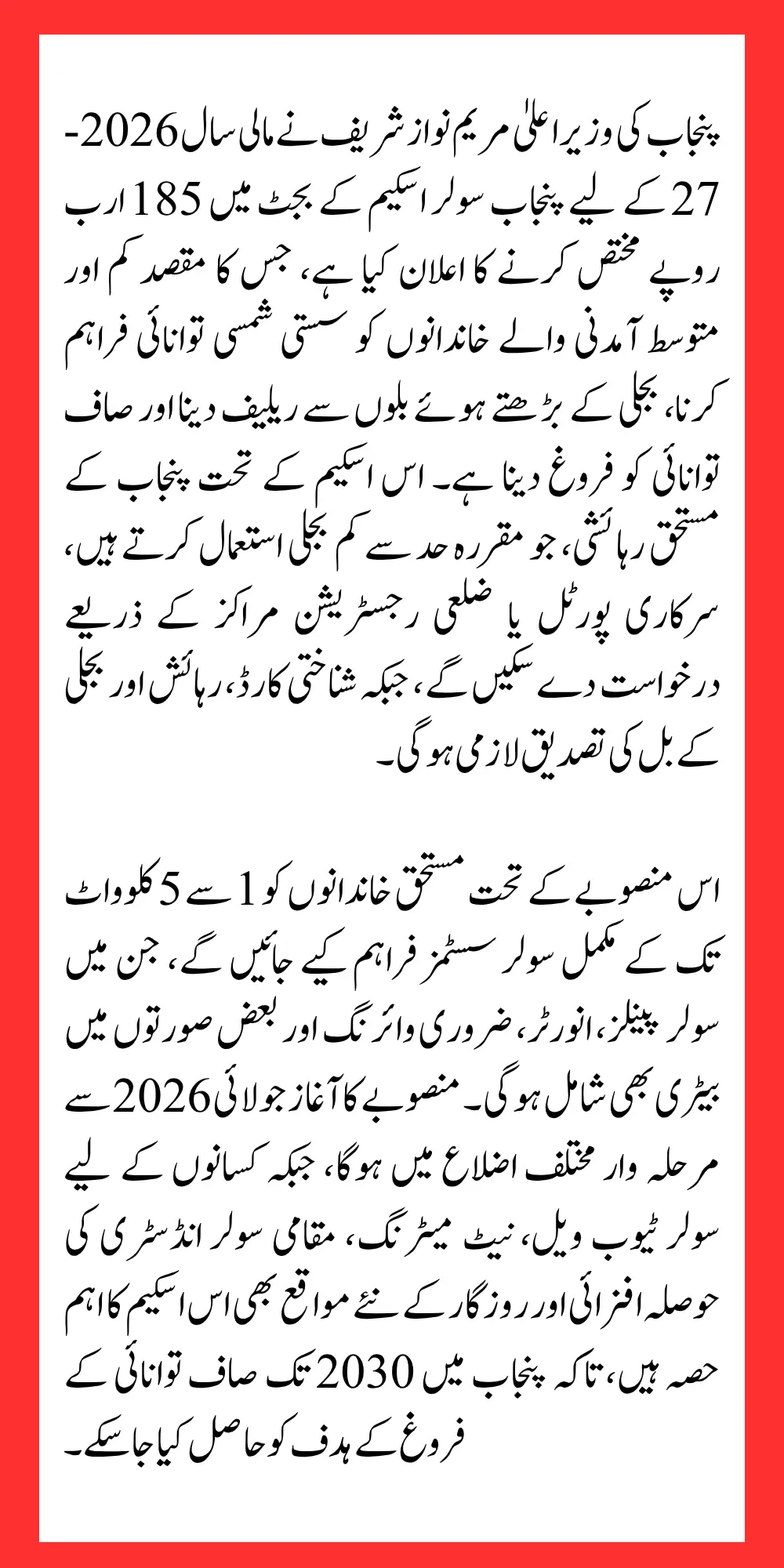
New Budget For Punjab Solar Scheme 2026-27: Punjab Chief Minister Maryam Nawaz Sharif has officially announced a landmark budget allocation of Rs 185 billion for the Punjab Solar Scheme in the fiscal year 2026-27. This significant financial commitment marks a major turning point in Pakistan’s renewable energy journey, with the Punjab government taking a leading role in shifting households and small businesses away from expensive grid electricity. The scheme is designed to provide affordable solar solutions across the province, reduce the burden of rising electricity bills, and promote clean energy access for millions of families who have long struggled with power outages and high utility costs.
Punjab Solar Energy Initiative 2026-27: Rs 185 Billion Commitment
The Punjab government under Maryam Nawaz has dramatically scaled up its solar energy ambitions by raising the budget allocation to Rs 185 billion for 2026-27, a substantial increase from the previous year. This enhanced funding signals a serious policy shift toward renewable energy adoption at the grassroots level. The move comes at a time when electricity tariffs in Pakistan have reached historic highs, forcing households to seek alternative power solutions. By investing heavily in subsidized solar installations, the government aims to bring meaningful relief to low and middle-income families across Punjab.
| Feature | Details |
|---|---|
| Total Budget | Rs 185 Billion |
| Fiscal Year | 2026-27 |
| Target | Low & Middle Income Families |
| Solar Capacity | 1 kW to 5 kW Systems |
| Registration | Online Portal & District Offices |
| Required Documents | CNIC, Residence & Electricity Bill |
| Launch | July 2026 (Phase 1) |
| Extra Benefits | Net Metering & Solar Tubewells |
The increased budget is also expected to stimulate local manufacturing and create thousands of jobs in the solar technology sector. With such a large-scale rollout planned, companies involved in solar panel production, installation, and maintenance stand to benefit significantly. The government has indicated that preference will be given to locally assembled solar products to support Pakistan’s growing renewable energy industry and reduce dependence on imported equipment.
You Can Also Read: Punjab Agriculture Transformation Plan Brings New Opportunities for Modern Farming
Free Solar Panels Eligibility and Application Process Punjab 2026
The Punjab Solar Scheme 2026-27 continues to prioritize families falling in the low-income bracket, with eligibility criteria linked to NADRA data and existing subsidy databases. Applicants are required to be registered residents of Punjab and must not have previously benefited from similar government solar programs. The scheme focuses on households with monthly electricity consumption below a specified unit threshold, ensuring that those most burdened by electricity costs receive priority access.
To apply, eligible citizens can visit the official Punjab government portal or designated district offices where registration camps are being set up across urban and rural areas. The process involves identity verification through CNIC, proof of residence, and confirmation of electricity bill history. The government has also introduced a helpline and mobile registration units to facilitate applicants in remote areas who may not have easy access to digital platforms.
Key Technical Features of the Punjab Solar Scheme 2026-27
- Each beneficiary household will receive a complete solar system ranging from 1 kW to 5 kW depending on energy consumption needs and family size.
- The systems include solar panels, inverter units, battery storage where applicable, and all necessary wiring and installation hardware.
- Installation will be carried out by certified technicians deployed through government-approved vendors across all 36 districts of Punjab.
- Net metering facility will be enabled for eligible households allowing them to sell surplus electricity back to the national grid and earn income.
- The systems come with a multi-year warranty covering both panels and inverters ensuring long-term reliability and after-sales support.
- Priority districts include southern Punjab regions such as Multan, Dera Ghazi Khan, Bahawalpur, and Rahim Yar Khan where power outages are most frequent.
You Can Also Read: CM Maryam Nawaz Sharif Solar Panel Scheme Previous Registration Eligibility Ballot Result
Punjab Renewable Energy Policy Goals and Economic Impact 2026
The broader objective behind the Rs 185 billion solar budget is to position Punjab as a model province for clean energy transition in Pakistan. Maryam Nawaz has outlined targets to install solar systems across hundreds of thousands of homes, schools, and small commercial units within the next fiscal year. This initiative aligns with national climate commitments and the federal government’s push to increase renewable energy’s share in Pakistan’s total power mix to 30 percent by 2030.
Economically, the scheme is projected to reduce Punjab’s overall electricity import demand from the national grid, easing pressure on transmission infrastructure and helping stabilize power distribution across the province. Families benefiting from the program are expected to save thousands of rupees monthly on electricity bills, money that can be redirected toward education, food, and healthcare. The government also anticipates that widespread solar adoption will reduce load shedding pressure in residential areas, improving quality of life for millions of Punjabis.
Solar Scheme Disbursement Timeline and District-Wise Rollout
District-Wise Rollout and Implementation Schedule
- Phase one of the 2026-27 rollout will begin in July 2026 covering major cities including Lahore, Faisalabad, Multan, and Rawalpindi with initial registrations already underway.
- Phase two will expand coverage to smaller towns and rural tehsils by October 2026 with dedicated teams assigned for each administrative zone.
- District coordination committees have been formed under Deputy Commissioners to oversee fair distribution and prevent any misuse or duplication of benefits.
- A real-time tracking dashboard will be launched enabling citizens to monitor application status, installation schedules, and scheme progress online.
- Complaints and grievance redressal mechanisms have been built into the scheme with a dedicated ombudsman office handling disputes within 15 working days.
- Special quotas have been reserved for widows, disabled persons, and transgender individuals recognizing their vulnerability and energy poverty levels.
You Can Also Read: Free Solar Scheme Registration Portal Reopen Know How to Apply
How Punjab Solar Scheme 2026 Compares to Previous Year Budget
When compared to the previous year’s allocation, the Punjab Solar Scheme budget for 2026-27 reflects a dramatic scale-up in government ambition and spending. The increase to Rs 185 billion represents a significant jump aimed at accelerating the pace of installations and widening the coverage net to include previously underserved communities. Officials have stated that lessons learned from the earlier phases of the scheme have been incorporated into the new implementation framework, particularly around improving the speed of installation and reducing bureaucratic delays that slowed progress in the pilot rollout.
The expanded budget also allows for greater flexibility in offering customized solar solutions based on household needs rather than one-size-fits-all packages. This nuanced approach is expected to improve satisfaction rates among beneficiaries and ensure that the systems installed actually meet the energy demands of recipient families. Independent energy experts have praised the increased financial commitment while calling on the government to ensure transparency in vendor selection and installation quality to maximize the scheme’s long-term impact.
Punjab CM Solar Scheme 2026-27 Benefits for Farmers and Rural Communities
Rural Punjab stands to gain enormously from the expanded solar scheme as agricultural communities face some of the harshest effects of electricity shortages and high tubwell operation costs. The 2026-27 budget specifically carves out resources for solar-powered agricultural tubwells, helping farmers reduce their dependence on diesel generators and expensive grid electricity for irrigation purposes. This targeted support for the farming sector is seen as a critical component of Punjab’s broader agricultural productivity agenda.
Beyond tubwells, rural households in off-grid and semi-grid areas will gain access to reliable electricity for the first time or on a more consistent basis through the solar rollout. Schools and basic health units in remote areas are also part of the coverage plan, with the government aiming to ensure that public service delivery is no longer disrupted by power cuts. The combination of household and institutional solar installations in rural zones represents one of the most comprehensive rural electrification pushes Punjab has seen in recent years.
You Can Also Read: Maryam Nawaz Cross Subsidy Electricity Bill Scheme Registration Portal Announced
Maryam Nawaz Vision for Clean Energy Punjab 2030
- The Punjab government aims to install over one million solar systems across the province by 2030 as part of a rolling multi-year solar expansion strategy.
- A dedicated Punjab Renewable Energy Authority is being considered to regulate, oversee, and scale solar and wind energy projects across the province independently.
- Future phases of the solar scheme will explore community solar setups where multiple households in a single neighborhood share one large solar installation and split the benefits.
- Integration with digital payment platforms will allow beneficiaries to manage their solar credits and net metering earnings directly through mobile banking wallets.
- The government plans to introduce skill development programs training thousands of young Punjabis as certified solar technicians to build a local green workforce.
- Maryam Nawaz has stressed that clean energy access is a fundamental right and the administration will continue to prioritize it as a core pillar of the Punjab development agenda through 2030 and beyond.